Dancing Faun
Fonderia Chiurazzi Grand Tour Bronze
Dancing Faun
Fonderia Chiurazzi
Naples, Italy
Bronze Sculpture
After the Ancient Bronze Original from Pompeii
32 in.
Late 19th / Early 20th Century
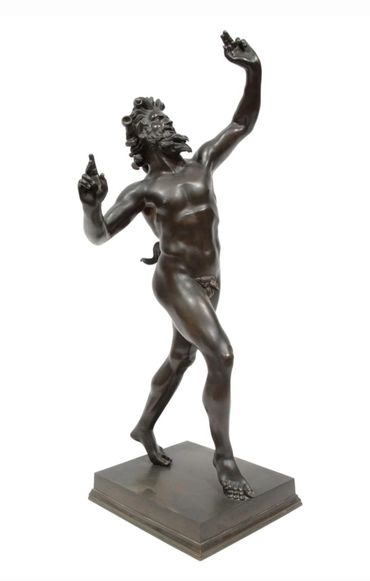
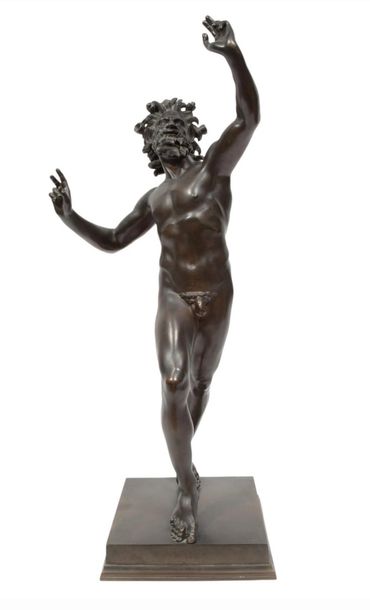
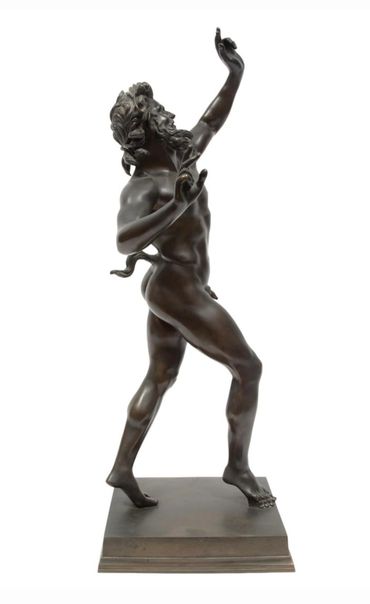
A superb and highly expressive bronze reduction of the celebrated Dancing Faun, cast by the renowned Fonderia Chiurazzi of Naples, Italy—arguably the most esteemed 19th–20th century foundry for Grand Tour bronzes after the antique. This example captures, with exceptional fidelity and vitality, the famed ancient Roman sculpture discovered fully intact in the House of the Faun in Pompeii.
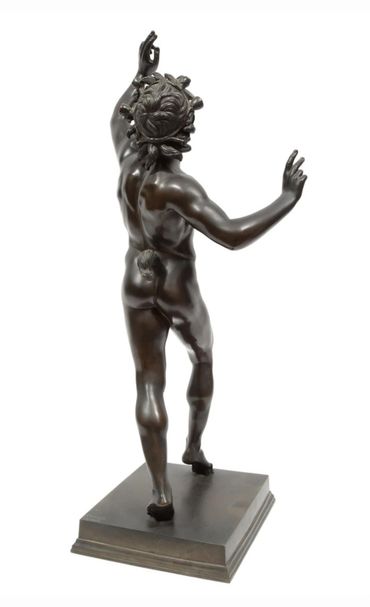
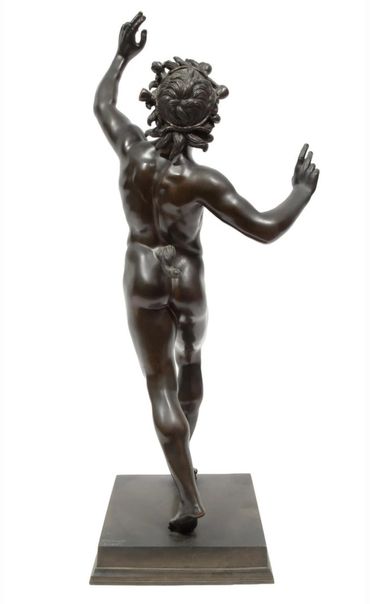
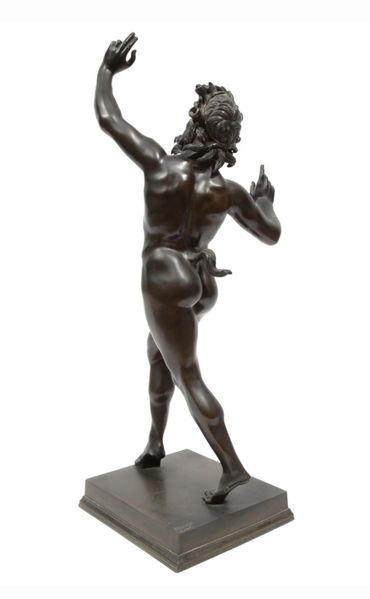
The figure is rendered in a moment of ecstatic motion—arms raised, torso twisting, weight shifting dynamically through the hips and legs—imbuing the work with a sense of rhythm and abandon that feels remarkably modern. The anatomy is beautifully modeled, muscular yet refined, with the Chiurazzi workshop’s hallmark attention to surface nuance: softly burnished planes contrast with crisp detailing in the hair, beard, and expressive hands. The dark, rich patina enhances the sculpture’s sculptural depth, catching light across the contours in a way that emphasizes both movement and form.
Satyrs and fauns—mythological companions of Bacchus—embody the duality of nature: instinct and beauty, wildness and grace. Here, that spirit is distilled into an object of both scholarly importance and decorative power. The composition reads effortlessly from every angle, making it ideal for placement in the round, whether on a pedestal, console, or as a focal point within a curated interior.
The Chiurazzi foundry was revered for its unparalleled ability to translate ancient marbles into bronze with extraordinary precision, often working from direct casts taken in Italian museums. Their works are held in major American institutions, including the Getty Villa and the John and Mabel Ringling Museum of Art, underscoring the historical and artistic significance of their production.
A museum-quality example—rare at this scale—offering both connoisseurship and presence.
Details
- Origin: Naples, Italy
- Foundry: Fonderia Chiurazzi
- Medium: Bronze
- Height: 32 inches
- Date: Late 19th / early 20th century
- Condition: Excellent, with a beautifully preserved patina; ready to place
Provenance
After the antique Roman original excavated at Pompeii, 1st century BCE/CE.=
Literature / Notes
The original Dancing Faun remains one of the most iconic survivals of Roman sculpture, celebrated for its animation and naturalism—qualities faithfully and elegantly captured in this exceptional Chiurazzi casting.
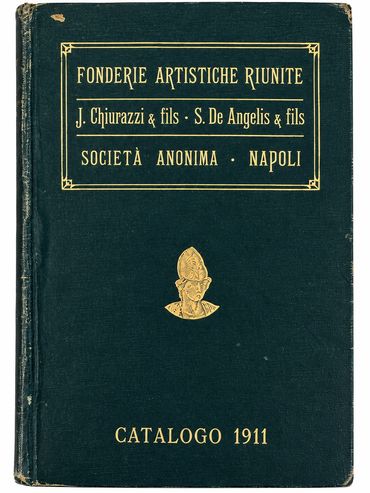
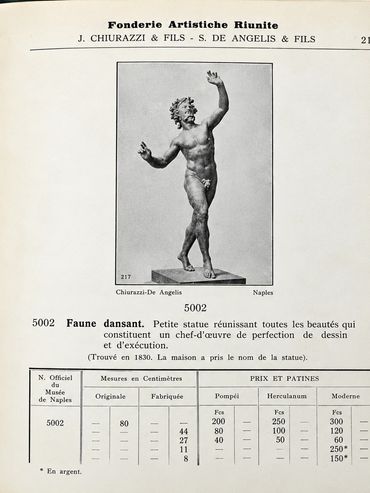
1911 CHIURAZZI CATALOG DOCUMENTATION
The Dancing Faun model is documented in the 1911 catalog of Fonderie Artistiche Riunite — J. Chiurazzi & fils – S. De Angelis & fils, Naples. On page 217, it appears as “Faune dansant,” No. 5002, with a recorded height of 80 cm (approximately 31.5 inches), closely corresponding to the 32-inch height of this bronze.
This example bears the “Chiurazzi Napoli” inscription on the base, providing physical evidence supporting its attribution to the Neapolitan foundry. The 1911 catalog documents the model within the firm's historical production; its inclusion does not by itself date this individual casting specifically to 1911.
Maison Palm Beach maintains a period copy of the 1911 catalog in its research archive.
Read more: The Artistry of Chiurazzi: Naples and the Grand Tour
Price $15,000
Dancing Faun